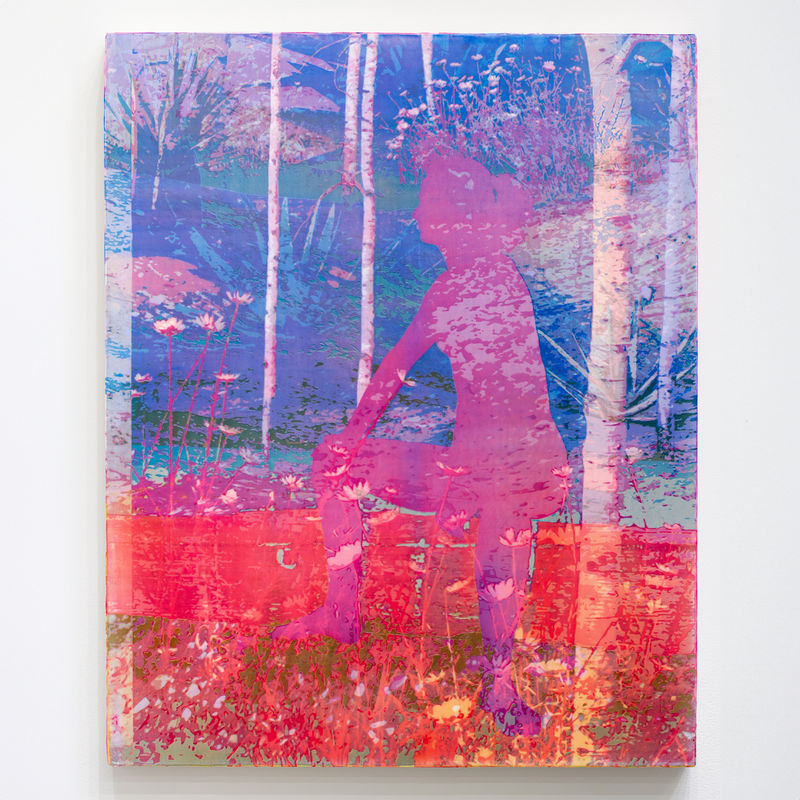
Stillness of, 2025
Acrylic on Canvas-Wrapped Panel
30" x 24" x 1 3/4" (76.2 x 61 x 4.4 cm)
Unique
(ZoWa.25416)
When you study the history of Western painting, scenes of amorous display often centralize a heterosexual gaze enmeshed within the aesthetic strictures of the academic landscape genre. Walsh went ahead and transformed this into a show of not only queer visibility, but queer reclamation. The figures are situated in a plane of reverie denoted by the tranquilly sensuous atmosphere overflowing in prismatic illuminations. Their bodily gestures, too, reveal a sense of liberation - a lone figure with a leg bent like an explorer as they gaze off into the distance, a man and a woman whose bodies affectionately coalesce within the branches of a tree, and multiple scenes of reposed daydreaming.
An impressive aspect to Walsh’s paintings is that this emotive power is consistent irrespective of the scale of works as their compositions in the exhibition range from conventional painterly dimensions (around 30 x 24 inches) to a nearly wall-to-wall work comprising three canvas-wrapped panels.
Pleasure as a form of agency for an individual and an entire community was one of the lasting takeaways I reaped from both viewing Walsh’s works and reading the stories behind their inception from the show’s beautifully composed press release. The settings for these images are deeply Los Angeles-rooted - the parkland scenes deriving from Griffith and Elysian, which is where many of Rocco’s works were filmed. Walsh’s sites of nature as metaphors for liberation and open expression made me think of the ways in which this idea can be seen as an evolution from some notable predecessors, namely 18th Century Rococo fête galante paintings and Henri Matisse’s recurrent cavorting nude figures. Much like these earlier art historical examples, Walsh’s resplendent works accomplish similar sensations, but their work is totally in a league of its own on account of the nuance brought to its technical and narrative weaves.
