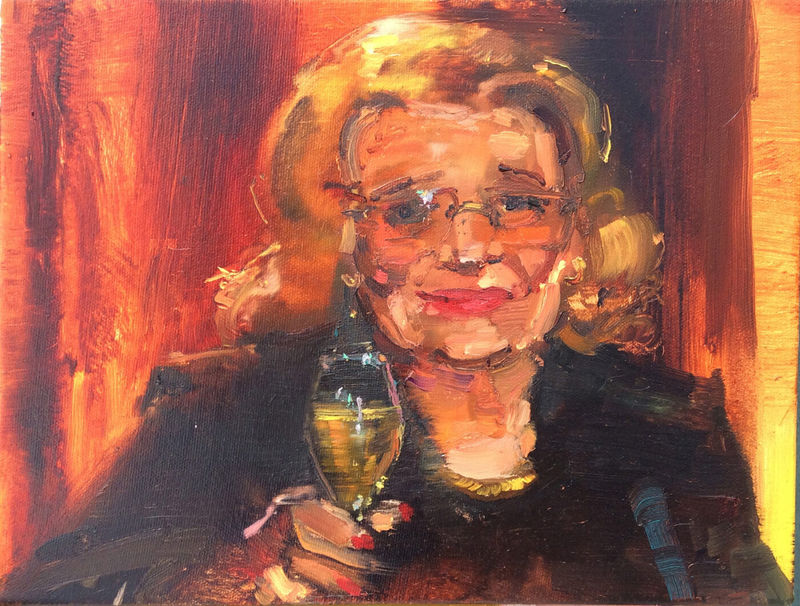
To sit for a portrait and feel seen by the artist is one of those romantic notions that has persisted for centuries. It may sound sentimental, but I know it holds up because when Angela Dufresne painted my portrait a few years ago, the resulting oil on canvas captured something truer than most photographs of me have been able to do. I believe that Dufresne is one of the greatest painters of our time. She brings the dark glamour of cinema onto the canvas by channeling the unruly mastery of actresses like Jessica Lange and Gena Rowlands. This interview took place during Dufresne’s residency at Dartmouth, where she arrived with her partner, the painter Mala Iqbal, and their two dogs. We spoke about the generative volatility of collaboration, Kathy Acker’s “eye,” fly fishing, and Dufresne growing up queer in 1980s Kansas with late-night cable as the only escape.
Ksenia M. Soboleva
Your practice is deeply rooted in cinema, both the history of European cinema and American Hollywood. You’ve described growing up with “a TV in your face.” Can you talk about how that early immersion in cinema shaped the way you think about painting?
Angela Dufresne
Sadly, my family was totally subsumed by TV. Participants in a manufactured reality. TV replaced books, socializing, and general human interaction with the exception of the rare holiday occasions. It was Kansas. It was the suburbs, and I was a dorky, wandering-eyed, closet case with no role models to speak of and few friends in my profound dorkdom. I found my role models on TV, however off base my interpretations were. MTV and late-night cable were my escape from 1980s Kansas, where I developed obsessive crushes on Jessica Lange and Nastassja Kinski that fueled fantasies of fleeing to LA—fantasies that eventually helped me leave behind the suffocating patriarchy I watched destroy my mother. Misinterpretation is a vehicle for new meaning-making and is, of course, so gay. I paint with the non-patriarchal imagination and its deliberate misinterpretation that I developed during the period of my miserable early life that reverberates so harshly today through MAGA.
KMS
In his essay for your Dartmouth show, William E. Jones invokes the figure of the diva; he’s talking about Maria Callas, but it struck me that many of the actresses you depict in your paintings also hold this identity. To me, the diva represents an unapologetic unruliness and being “too much,” a refusal to shrink. It feels like a dying breed. Can painting hold onto that sensibility?
AD
Yes, more women refusing to shrink and flourishing their mastery, please! Jessica Lange was my first gateway-drug diva. I’ve found many more since then! Gena Rowlands isn’t a classic diva, though; she’s textured differently. She wore the persona and used its power strategically and very much against the grain of patriarchy. Rowlands had no blocks that prevented her expressing her excellence. She shares that with Alice Neel, who is a huge influence for me. These artists don’t glorify freedom or struggle; they use their masterfulness to witness and interpret in radically porous ways. I think that is what Rowlands and Neel gave us permission to do. You get the sense that they’re allowing themselves to do the thing that they’re naturally best at, and it’s totally authentic. As a painter, Neel allows the virtuosity to come through, not to win some battle with history but to bear the affliction and the agency of her subjects. She leaves their individuality intact but mutated by her razor-sharp gaze. I suppose Neel was a diva, however grungy. She balanced virtuosity, spontaneity, and rawness like Rowlands. I take that seriously. The things I need to paint need the same palette of ingredients and care. We need new forms of virtuosity, for certain.
KMS
Over the past few years you’ve been collaborating with your partner, the painter Mala Iqbal. I loved the title of your joint exhibition, Where I End, We Begin, at the State University of New York at New Paltz. You join a lineage of brilliant lesbian artists making work together, like Claude Cahun and Marcel Moore, though art history has long refused to credit two people, pushing the myth of the solitary genius. What does collaboration mean to you, and what does it look like in practice?
AD
Collaboration with Mala is less humbling than working side by side with her in a studio, which I’m doing right now here at Dartmouth. By less humbling, I mean that when you’re collaborating you’re pooling resources for work. I firmly believe it’s what we should be doing as a species. Seeing Carrie Moyer and Sheila Pepe’sTabernacles for Trying Times, as well as Anoka Faruqee and David Driscoll’s coauthored practice, inspired us. What insufficiencies you may have are usually counterbalanced by the person you’re working with in unexpected ways. Mala and I do that amazingly well when we create works together. Working next to Mala is humbling because she has such a vast range of resources as an artist and in life in general: her humanity; the incomprehensible vastness of her imagination, both dark and loving; her sensitivities, raw talent, and tools as a painter. She’s so insanely inventive and has the most ethical and immense effectual memory I’ve ever been close to. That’s humbling to witness; I feel small next to her. That’s a good thing. It proves to me that the great art centers—Florence, Paris, New York City, Mexico City—flourished not because of nations but because artists could afford to live near each other, take risks together, and raise the stakes. That generative volatility of working side by side is what art schools try to replicate.
KMS
The way you paint is wonderfully performative, physical, energetic. When you painted my portrait, I was struck by how quickly it went: a painting in four hours! The immediacy felt extraordinary. Do you paint differently with a live model versus working from imagination or an image? How do your surroundings seep into the work?
AD
Philip Guston famously said that you’re not truly making work until all the voices in your head—critics, friends, history—leave the studio, and then you leave too. While I believe that’s true for Guston, and I love those paintings, it’s a bit different for me. In a strange way, everyone leaves the room when someone is physically there with me and I’m making a portrait. The stimulation—visual, emotional, conversational—overpowers self-consciousness, ego, and habit. It affirms Carl Jung’s idea that we discover who we are through others. Working on a portrait, I’m in a total state of responsiveness; that’s where I actually leave the room. I don’t know how I make those paintings, but I sense when they work, when to let go, when to give more. Likeness isn’t the goal; they manifest a specific persona out of the relational exchange. This happens more fluidly when painting from life: I’m more inventive; I locate resources I can’t just will into being.
I want to mention Kathy Acker, though it’s not a one-to-one comparison given the differences between writing and painting. Still, she articulates a shift in how we can think of ourselves to act outside patriarchal and bourgeois structures. She’s interested in being “eye,” not “I.” She writes about this in Portrait of an Eye and elsewhere. It frames her move away from a traditional subject position toward something more detached or voyeuristic. I’m not interested in detachment or objectivity, and I don’t think Acker ever pulled either off, thankfully. But the ontology of “eye” versus “I” is very prescient for me.
KMS
Tell me about fly-fishing, which is a great love of yours. A friend took me once, and it was a beautiful immersion into nature, but not relaxing the way I expected; you’re fighting the force of the river, staying on your feet. Less a practice in patience than a practice in presence. I forgot all about the fish. What is it like for you? What does it do?
AD
Fly-fishing is the third most immersive thing I’ve ever done; first is of course sex, then painting, then fishing; after that it’s cooking. Its real bounty is the particular natural environments, and rivers are particularly sexy for me. It’s the most meditative thing I’ve ever done, but, no, it’s not relaxing; it’s obsessive, transfixing, and highly addictive. It resembles the not-“I” of painting from life; you literally have no idea who you are or what your life is when fixated on getting a fish that’s rising to take your fly. You lose all sense of time, of yourself, like when you’re totally entangled in a painting. The smells, sounds; the birds, bears, beaver, and deer you see. I’ve always lived in such highly constructed realities. It’s weird to think eagles, fisher cats, beaver, and fish are still out there given what humanity has wrought on this earth. Also, you’re thinking about bugs, the position of fish in the water, the eddies, hearing every little splash, seeing every breach of the surface of the water trying to seek out a fish. If you stay out past sunset on a river you often bump into a beaver, who swims underwater to within about ten feet of you; then they’ll pop up, and hoist their tail, smacking it onto the surface of the water to scare the shit out of you and get you the fuck out of their pool. It’s a wonderful check-in with reality.
For me, looking long and hard at the actual things around me is the most profound reaction I can conjure in my practice these days. While fishing, I’ve willfully abandoned cultural and technological contemporaneity to turn the other cheek, to look elsewhere, at the water, the ground where things decay and regrow. It’s certainly not a disengagement so much as a refusal to continue my expected behaviors as a social being.
Angela Dufresne: Artist-in-Residence is on view at the Jaffe-Friede Gallery at Dartmouth College in Hanover, New Hampshire, until March 8.
